In
this lesson, students will examine a rectangular prism or cylinder.
Before this lesson, have students bring in common objects that are
either cylinders or rectangular prisms. Have a collection of additional
items ready to distribute if needed.
As a prerequisite to this lesson, students must be able to
compute the surface area and volume. The applets listed below can be
used to provide a visual demonstration of surface area and volume of
prisms in class, or students can use these applets to explore on their
own.
To engage students in this lesson, show a scale model, such as a Hot Wheels® toy car or an HO scale train replica.
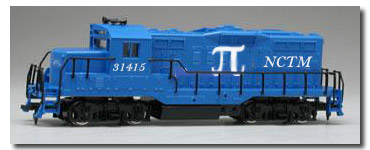
The Hot Wheels® Monster Jam® car on the Scaling Overhead is built on a 1:24 scale; HO scale train replicas are built on
a 1:87 scale. That is, the scale factor is the number by which each
dimension of the original object is multiplied to find the
corresponding dimension of the model. (Note that in these examples, the
scale factor is less than 1, which means that the model is smaller than
the original object. In this lesson, students will consider a model for
which the scale factor is greater than 1, which means that the model
will be larger than the original.)
 Scaling Overhead
Ask students when they have seen a scale model. They may mention
models of buildings, neighborhoods, or monuments. Most students have
seen miniature replicas of famous places, such as the Eiffel Tower or
Empire State Building.
Say to students, "Suppose you wanted to build an exact replica
of your object, enlarging it by using a scale factor of 5. Picture in
your mind how it would look. How many times larger do you think the
surface area will become? How many times larger do you think the volume
will become?"
Distribute the Scaling Away Activity Sheet. Explain to students that they will record their hypotheses,
measure the dimensions of their object, and compute its surface area
and volume. Then, they will choose a scale factor, determine the
dimensions of a model using that scale factor, and compute the surface
area and volume of the model. Finally, they will examine what happens
to the surface area and volume. After working through the questions on
the activity sheet, the students will discuss their findings as a
class.
 Scaling Away Activity Sheet
For Question 1, students are to predict what they think will
happen to the surface area and volume of an object when each dimension
is increased. Allow students to write a conjecture, and then discuss as
a class. Explain to students that they will test their conjectures
during this lesson.
After the discussion, distribute rulers or tape measures and
have students work independently on Questions 2-4. As students work,
check for accuracy in their measurements and calculations. Discuss the
advantage of computing with decimals in the metric system instead of
fractions in the customary system.
When computing surface area and volume, a useful mnemonic for students is the FSC2 method: Formula, Substitute, Compute, Correct units.
To help students compute the surface area of their object, you may want to use the Surface Area Overhead. This overhead helps students to organize the information when
finding the area of each of the parts of a three-dimensional object. (A
similar template could be used to find the volume.)
Surface Area Overhead
Note that questions about surface area appear before questions
about volume on the worksheet because of the transition from one to two
to three dimensions—that is, from length to area to volume. However,
students may be more successful computing volume before computing
surface area.
Students next determine the dimensions of the model using
their scale factor from Question 5, as well as the surface area and
volume in Questions 6-7. A common misconception is to simply take the
previous calculations and multiply by the scale factor to find the
surface area and volume of the model. This is not correct! Make sure
that students use the same procedure that was used previously, which
involves identifying the correct formula, substituting, computing, and
labeling the solution with the correct units.
If students compute accurately, they will discover how much
larger the model is than the original. By answering Questions 8-9,
students should notice the following:
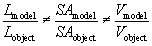
That is, the ratio between the length of the object and the length of the model is not equal to the ratio of surface areas, and neither of these is equal to the ratio of volumes.
The Scaling Ratios Overhead may be helpful for finding the ratios.
Scaling Ratios Overhead
Earlier in the lesson, students chose a scale factor, n. Students should now find that the numerator for the ratio of surface areas is n2, and the numerator for the ratio of volumes is n3.
Allow students to compare their answers. Students who chose the same
scale factors should verify that they got the same ratios in
Questions 8-9.
The following algebraic explanation may help students understand why the surface increased by a factor of n2 and why the volume increased by a factor of n3.
|
If the original object was a prism, it had dimensions l, w, and h.
The dimensions of the model are equal to the dimensions of the object multiplied by the scale factor n, which are nl, nw, and nh.
Original surface area:
2lw + 2lh + 2wh New surface area:
| 2(nl)(nw) + 2(nl)(nh) + 2(nw)(nh)
| = 2n2lw + 2n2lh + 2n2wh | | | = n2 (2lw + 2lh + 2wh) |
Original volume:
lwh New volume:
(nl)(nw)(nh) = n3(lwh)
|
A similar argument could be used to show why the surface area and volume of a cylinder increase by the same factors.
As students discover this relationship, they will understand the
effects of scale factors on volume and surface area. More importantly,
they will begin to develop an understanding of why square units are
used for area and why cube units are used for volume.
It is most important for students to discover this relationship
on their own. If they cannot write their own conclusion at first, be
patient. Exploring the results for other scale factors, hearing about
the results of their classmates, and investigating other objects may
help students to grasp this important mathematical concept.